Thursday, March 1, 2012

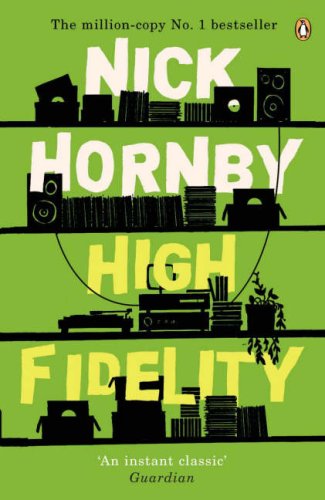
High Fidelity Book Review

Nick Hornby’s novel High Fidelity is a story about Rob Fleming, the middle aged owner of a failing record shop, Championship Vinyl, in north London. Rob’s girlfriend Laura has left him for the guy who lives upstairs, and Rob tries to find comfort in his loser coworkers Dick and Barry and his huge collection of LPs. After Laura, Rob spends his days doing what he does best: trudging along through his day, revising and reviewing the top 5’s of everything, like his top five episodes of Cheers, top five records (which he can’t seem to make his mind up), top five films (Reservoir Dogs) and any other list that a music and pop culture junkie would constantly be making and thinking about. With the lack of eventfulness of Rob’s lonely middle aged life, Hornby depicts what every lonely middle aged man would probably feel after the one woman that he really felt something for moves out: a bed with a restless figure and a restless mind sleeping the winter chill in sheets of linen, longing to fall asleep so that he can perhaps wake up to find someone important softly sleeping next to them. There are heavy moments in the novel that make the reader feel this way, but High Fidelity has its light moments as well, which come in to rescue the reader and make them eventually realize that everything is probably going to be okay, despite all the existential protests that suggest otherwise. Hornby rescues his readers from a downward spiral into pure melancholy through the spontaneous, and sometimes unexpected spouts of humor, such as Rob crying when he hears an American recording artist named Marie do a rendition of “Baby, I Love Your Way” at a seedy music venue. Rob’s interpretation of the people around him and the conversations with them provide humor as well, such as Rob’s description of his annoying coworker and acquaintance Barry: “He comes into the shop humming a Clash riff. Actually, ‘humming’ is the wrong word: he’s making that guitar noise that all little boys make, the one where you stick your lips out, and clench your teeth and go ‘DA-DA!’ Barry is thirty-three years old” (Hornby 41). Among the humor, Hornby provides an assortment of pop culture, mostly music, references that would make any music nerd tremor in excitement when they read about Rob’s fondness for good records and collections and unreleased Elvis Costello demos and Sex Pistols EPs.
Through all that Rob goes through, it is expected that he comes out of this season of loneliness with bitterness and the desire to hide away to avoid any human contact. Rob is able to realize that maybe it is people that he needs in his life. Hornby’s protagonist, who could have been considered an antihero in the beginning of the novel from all the terrible ways he treats people, begins to transform into a thoughtful human being who is tired from the weight of this heavy world, and sees that he really does need people. Rob later concludes “It's only just beginning to occur to me that it's important to have something going on somewhere, at work or at home, otherwise you're just clinging on [...] You need as much ballast as possible to stop you from floating away; you need people around you, things going on, otherwise life is like some film where the money ran out, and there are no sets, or locations, or supporting actors, and it's just one bloke on his own staring into the camera with nothing to do and nobody to speak to, and who'd believe in this character then?”  (Hornby 74).To win Laura back, Rob realizes that perhaps he needs a change in himself. Rather than needing a change to his goals or ambitions, or his career as a record shop owner, like his mother suggests, he senses a need for an internal change. Rob sees that maybe he can look past his elitist views of music (Laura doesn’t own very many outstanding records), and maybe put together a “compilation tape for her, something that’s full of stuff she’s heard of, and full of stuff she’s play” (Hornby 323).
Nick Hornby uses Rob to communicate some of the most relatable statements, such as “...sentimental music has this great way of taking you back somewhere at the same time that it takes you forward, so you feel nostalgic and hopeful all at the same time” (Hornby 63).  Above all, even though the story is from a male perspective, Hornby’s novel is a story of adulthood, and eventually the human experience; his story is a double-edged sword that cuts away at the most calloused of readers, getting to the soft and spongy, and latching on to the difficult to get to core that is found in every person, that convicts them of the similarities that they share with Rob, and eventually the similarities that all human beings share. The novel builds a connection between its reader and the Rob’s thoughts and feelings.

Thursday, February 16, 2012

Rob and Grendel.

My character Rob from High Fidelity, could be compared to the protagonist Grendel in John Gardner's Grendel. While Rob is a plain, middle-aged, owner of a failing record shop in London, and Grendel is a a huge hairy beast that feeds on flesh of the Danish people, there are some strange similarities. First of all, both the middle aged man and the god knows how old monster are jerks. Rob even describes himself, mulitple times, as an "arsehole." So there you go. Rob was in a relationship for a while with Laura. While they were dating, he willingly accepted a lot of money from Laura to help keep his record shop going, while she worked at an attorney's office. At the same time, Rob was having an affair with another woman, and Laura also happened to be pregnant. Rob and Laura eventually break up, which sets off most of the plot to the novel. Rob still owes Laura a lot of money. Grendel is a savage beast who eats people. For approx 12 years, Grendel has been eating the Danes of Hrothgar's kingdom. From that, it's easy to see that Grendel is a jerk. Both, however, are antiheros, rather than villains. The books both explain why Rob and Grendel are this way. Isolation is a big factor in to why the characters act the way they do. Rob has always felt isolated and lonely, due to the rejection that he has dealed with throughout his life with women. After Laura, Rob is even more bitter towards people. He really isn't close to anyone. The only people that he spends time with are the store clerks that work with him, and a few college friends that he rarely sees, and Marie. On his birthday, he gets a last minute get together at a pub, and only 4 people show up. Rob is most likely bitter towards people because he isn't close to anyone. He has dealt with rejection all his life, and the last thing he wants to do is try to become closer with someone else. Grendel is similar because of the way the Dane's treated him. Grendel wonders the wilderness alone, frusterated with life and all its mysteries, and is always asking why he is who he is. The Danes give him no chance to interact peacefully with them and attack him when they first see him. Grendel has no choice but to defend himself. This leads to Grendel's anger with the Danes and his hatred towards their worldview. Over time, he begins to despise humanity, and makes them his enemy. The fact that both Rob and Grendel deal with injustices through negative actions towards people, makes them sort of antiheroes (Rob is more an antihero than Grendel). They both want to have a connection to someone. They are lonely, and have dealt with isolation and have no one to really be there for them. They deal with this through hatred and bitterness, and violence and eating in Grendel's case.

Thursday, February 9, 2012

Truth in Bookz

In order to be non-fiction, a novel should have no fiction in it. Fiction is defined as the class of literature comprising works of imaginative narration. So if there is anything untrue or imaginary in a non-fiction novel, then it is no longer non-fiction because there is fiction in it.

I don't think half-truths are really acceptable. Obviously a memoir is the author's own account of their own events, but the author should at least be able to back up everything that they include, otherwise they could write that they had the ability to turn into a baby seal as a child, still calling their work with an obvious fictional element a memoir. Even if there is one untrue event in the novel, like baby seal morphing, then it shouldn't be a memoir, or non-fiction. Authors shouldn't be able to say whatever they want about their life and let people eat is up as truth. It's unfair.

I do not think there needs to be a line between genres, because genres typecast and categorize authors and novels too much. When it comes to ficion vs. non-fiction, I think that the line is quite clear anyway. If everything in the novel is true and happened, then it's non-fiction, because it contains no fiction. If there is something fictional in the book, then it becomes fiction.

Monday, January 30, 2012

I would not say that Genre Fiction is less worthy than Literary Fiction, but there certainly is a difference between the two. Yes, both Genre Fiction and Literary Fiction can have the same themes and motifs, but the difference is that these themes and symbols are delivered in a different way. Literary Fiction tends to have more depth and takes more dissection in order to understand the less apparant symbols, while in Genre Fiction, the themes are more apparant and the reader is carried by a faster, plot driven story, that takes little, in-depth examination. Popular books can still be great, it's just that popular works tend to be more accessable to the public, so it's less likely that the majority of readers who read for entertainment will choose a deep, "artisticly" written book, not to say that great books can't be artistic or very well written. It's just that someone looking for an entertaining book will be more stimulated by a plot driven book that doesn't hide its details. The reader is always the one who decides what good writing is. No one else.

I personally do not think that genre fiction really has its place in schools. I think that the way that literary diction is taught is the issue, not the fact that its exclusive. If there's no content in a genre fiction novel that cannot be uncovered through analytical practices that will help us in the real world, then there is really no point in teaching us that, since there isn't much to teach other than "read it."

Anyway. The way that literary fiction is taught is something that should be changed. If students are rushed, and are taught to read for test answers, then I feel that there is no point, because it's not like later on in life people will read so they can answer a test question. I like the way that I was taught to read Great Gatsby, for example. There was a deadline to finish, but it was not danger close. We were told to read at our own pace, but still dissect each chapter and try to develop an understanding of what the author was really saying, given the context of the culture that he wrote the novel in. While no one could uncover every single symbol and meaning in Great Gatsby, there was a sense of enjoyment and accomplishment to doing that. If I read the novel without any close examination, it would've been just a boring book about the 1920's. However, thanks to the way that I was encouraged to read the novel, I was able to find that the novel was much deeper than that, and I learned a new way of reading and analyzing text, which can help later in life.

I really hated the way I read Of Mice and Men though. We read it for test answers, reading only a few chapters, and then watching the movie. I feel like I missed out on a lot of good content and detail that I could've discovered if I had read the entire novel myself, rather than being guided through quickley, for test answers.
If kids are taught to read for test answers, then there's no authenticity, and the books hold little meaning to them. If people are taught to own what they read and read to find a meaning for themselves, then perhaps kids would be more enthusiastic about it.

Thursday, January 12, 2012

A Clockwork Orange would be very difficult to adapt into a film. The novel is filled with so much detail, and trying to figure out the dialogue can sometimes be like trying to solve a puzzle. Filmmakers would definitely have a hard time writing the script, in a way that the dialogue stays true to the Cockney Russian dialect that young Alex speaks yet is able to be understood by an audience watching the film. Filmmakers would also struggle with the violence of the novel for a film. It would also be tough for actors to learn the accents and dialects. The first part of the novel is Alex's moloko plus (milk spiked with absinthe) induced adventures as he commits ultra-violence, and it would be very difficult to cast someone who would have to act out violent brawls and intense rape scenes, because very few actors would want such a role.

The first scene that is essential to a Clockwork Orange film would be ultra violence in part one. At the height of their rage, Alex and his droogs Pete, Dim, and Georgie break into a house in a village outside the city and rape a woman in front of his wife. As terrible as this is, this scene is very necessary because it is the most raw and coarse way to show Alex and his droogs' total disregard for people, and the recklessness of their youth. Stanley Kubrick includes this rape scene in his adaptation, and probably directed one of the most disturbing scenes in film history. This definitely gave people a visual of Alex's crave for orgiastic violence.
Another scene that should be in an adaptation is the brainwashing that Alex volunteers for in prison so that he may regain his freedom. During the brainwashing, doctors condition Alex's body to become sick and ill whenever he even has the thought of committing violence. They do this by giving him chemicals as he is forced to watch extremely violent acts while his eyes are held open by contraptions. This is very important, because it leads to Alex's inability to free will, which is very important to the title "Clockwork Orange". This is used very well in Kubrick's adaptation, and is quite disturbing, seeing the way that even a violent person like Alex is feeling tortured by being forced to watch pure violence.
The last scene that needs to be in a film is after Alex's conditioning has wared off, and he has regained the ability to commit violence with new droogs. Later Alex is thinking about starting a family, and he has been less prone to violent acts. I think this is necessary because people need to see that Alex has the potential to change without the conditioning, and that he is capable of sweetness and juice without being programmed and mechanised like a clock.

The scene that I would not include in the novel would be when Alex drugs and rapes a pair of girls that he says look no older than 10. Kubrick includes this scene in the film, but the girls are much older than 10, and consenting, so Alex doesn't rape them in his adaptation. I can't really think of a filmmaker who would include that part of the noel verbatim. I would probably change up the circumstances like Kubrick did.
I would omit most of the scenes that Alex speaks with his parents. I would include them a little bit, but not a ton. Without the audience seeing Alex's parents, I think it would help with the mysteriousness and the lack of morals that Alex has, because his parents are rarely seen. I omit the part where Alex returns to them after prison to suprise them, and finds out that someone else took his place on the family. I found that part in the novel sort of irrelivent and did little to the plot.
The last scene that I would omit would be Alex being cured and actually deciding to leave violence behind. Kubrick's adaptation does this as well, and it leaves the audience wondering what Alex is going to do with his life, and if he'll continue with violence or choose a more righteous path.


"It would sharpen you up and make you ready for a bit of the ol' ultra-violence."