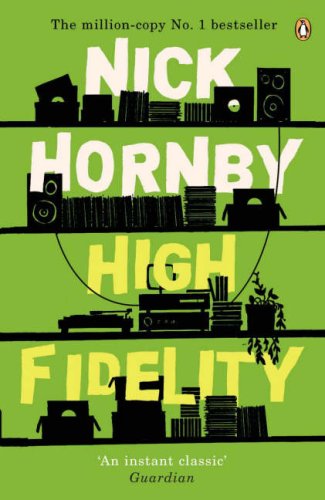
 Nick Hornby’s novel High Fidelity is a story about Rob Fleming, the middle aged owner of a failing record shop, Championship Vinyl, in north London. Rob’s girlfriend Laura has left him for the guy who lives upstairs, and Rob tries to find comfort in his loser coworkers Dick and Barry and his huge collection of LPs. After Laura, Rob spends his days doing what he does best: trudging along through his day, revising and reviewing the top 5’s of everything, like his top five episodes of Cheers, top five records (which he can’t seem to make his mind up), top five films (Reservoir Dogs) and any other list that a music and pop culture junkie would constantly be making and thinking about. With the lack of eventfulness of Rob’s lonely middle aged life, Hornby depicts what every lonely middle aged man would probably feel after the one woman that he really felt something for moves out: a bed with a restless figure and a restless mind sleeping the winter chill in sheets of linen, longing to fall asleep so that he can perhaps wake up to find someone important softly sleeping next to them. There are heavy moments in the novel that make the reader feel this way, but High Fidelity has its light moments as well, which come in to rescue the reader and make them eventually realize that everything is probably going to be okay, despite all the existential protests that suggest otherwise. Hornby rescues his readers from a downward spiral into pure melancholy through the spontaneous, and sometimes unexpected spouts of humor, such as Rob crying when he hears an American recording artist named Marie do a rendition of “Baby, I Love Your Way” at a seedy music venue. Rob’s interpretation of the people around him and the conversations with them provide humor as well, such as Rob’s description of his annoying coworker and acquaintance Barry: “He comes into the shop humming a Clash riff. Actually, ‘humming’ is the wrong word: he’s making that guitar noise that all little boys make, the one where you stick your lips out, and clench your teeth and go ‘DA-DA!’ Barry is thirty-three years old” (Hornby 41). Among the humor, Hornby provides an assortment of pop culture, mostly music, references that would make any music nerd tremor in excitement when they read about Rob’s fondness for good records and collections and unreleased Elvis Costello demos and Sex Pistols EPs.
 Through all that Rob goes through, it is expected that he comes out of this season of loneliness with bitterness and the desire to hide away to avoid any human contact. Rob is able to realize that maybe it is people that he needs in his life. Hornby’s protagonist, who could have been considered an antihero in the beginning of the novel from all the terrible ways he treats people, begins to transform into a thoughtful human being who is tired from the weight of this heavy world, and sees that he really does need people. Rob later concludes “It's only just beginning to occur to me that it's important to have something going on somewhere, at work or at home, otherwise you're just clinging on [...] You need as much ballast as possible to stop you from floating away; you need people around you, things going on, otherwise life is like some film where the money ran out, and there are no sets, or locations, or supporting actors, and it's just one bloke on his own staring into the camera with nothing to do and nobody to speak to, and who'd believe in this character then?” (Hornby 74).To win Laura back, Rob realizes that perhaps he needs a change in himself. Rather than needing a change to his goals or ambitions, or his career as a record shop owner, like his mother suggests, he senses a need for an internal change. Rob sees that maybe he can look past his elitist views of music (Laura doesn’t own very many outstanding records), and maybe put together a “compilation tape for her, something that’s full of stuff she’s heard of, and full of stuff she’s play” (Hornby 323).
Nick Hornby uses Rob to communicate some of the most relatable statements, such as “...sentimental music has this great way of taking you back somewhere at the same time that it takes you forward, so you feel nostalgic and hopeful all at the same time” (Hornby 63). Above all, even though the story is from a male perspective, Hornby’s novel is a story of adulthood, and eventually the human experience; his story is a double-edged sword that cuts away at the most calloused of readers, getting to the soft and spongy, and latching on to the difficult to get to core that is found in every person, that convicts them of the similarities that they share with Rob, and eventually the similarities that all human beings share. The novel builds a connection between its reader and the Rob’s thoughts and feelings.

